
'The Chinese military cannot advance much in Ladakh, even if they want to.' 'Similarly, in Arunachal Pradesh, they can rename a village or two, intrude here or there, but cannot do much more realistically.'
He said that the two nations will have issues in the foreseeable future. However, there are ways of addressing those issues and what happened in 2020 was not the way to address those issues.

India is hosting the 18th BRICS Summit in New Delhi, bringing together numerous world leaders including presidents from China, Russia, South Africa, Iran, and Egypt, along with prime ministers and foreign ministers from other nations. The summit will feature bilateral talks and highlights the expanded BRICS grouping's growing global influence and India's significant role as a founding member and current chair.

'It beggars belief that Saudi Arabia would deploy military force against India, a top partner and market.'

Bangladesh has not yet decided on Prime Minister Tarique Rahman's visit to India for the upcoming BRICS summit, with his office stating that Dhaka is awaiting New Delhi's response to its request for the extradition of deposed prime minister Sheikh Hasina and other 'fugitive criminals' currently residing in India.

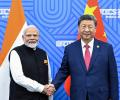
Prime Minister Narendra Modi cautioned against the 'weaponisation' of technology and critical minerals at the BRICS summit, advocating for cooperation to foster shared prosperity. Concurrently, Chinese President Xi Jinping announced plans for an open-source AI ecosystem for BRICS nations, positioning Beijing as a key technology partner amid global AI competition.

Bangladesh-China and Bangladesh-US relations have evolved from reluctant engagement to increasingly consequential strategic partnerships.
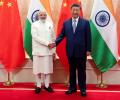
India and China celebrated the 75th anniversary of their diplomatic relations on Tuesday, with leaders from both countries exchanging congratulatory messages. The anniversary comes as the two countries are working to restore ties after a four-year freeze due to the military standoff in eastern Ladakh. Both countries have expressed a willingness to enhance strategic mutual trust and step up cooperation in various fields. The two sides are also exploring ways to rebuild ties and promote people-to-people exchanges.

'I know China will implode. It is scientifically impossible for China to control a nation through the barrel of a gun.'

External Affairs Minister S Jaishankar met his Chinese counterpart Wang Yi in Manila, reiterating that peace and tranquillity in border areas are prerequisites for normal India-China relations. He stressed the importance of mutual respect, interest, and sensitivity, while also raising concerns about market access, trade imbalance, and supply chain uncertainties.

India has strongly criticised China's practice of assigning 'fictitious names' to areas within Indian territory, stating that such actions are futile attempts to alter reality and negatively impact efforts to normalise bilateral relations.
Chinese Foreign Minister Wang Yi has called on India and China to view each other as partners rather than rivals, emphasising the importance of cooperation for regional stability and development.
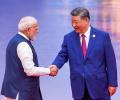
India's dual pursuit of a robust strategic partnership with Washington and a pragmatic, tension-management policy with Beijing represents the essence of modern multi-alignment. By embracing economic pragmatism, learning to compartmentalize political differences, and engaging in continuous dialogue, India can secure its borders, grow its economy, and contribute to a stable, multipolar Asian century, points out Ambassador Rajasekhar.

Relations between India and China have been in an 'abnormal state' since the 2020 Galwan clash and it is a 'possibly longer than medium-term issue', External Affairs Minister S Jaishankar said in New York.

A Chinese official stated that India and China should view each other as cooperative partners and opportunities for development, not rivals or threats. This statement came in response to Russian President Vladimir Putin's comments on the independent and strong ties Russia maintains with both nations, emphasising non-interference in India-China relations.

China has welcomed the appointment of Vikram Doraiswami as the new Indian Ambassador, expressing optimism for improved Sino-India relations. Doraiswami, a seasoned diplomat with experience in China, is expected to play a key role in managing complex bilateral issues and fostering cooperation.
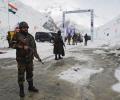
With Beijing remaining intransigent on the withdrawal of additional troops deployed by the People's Liberation Army (PLA) since the deadly border clash in 2020 in eastern Ladakh, India's bilateral ties with China remained frozen in 2023 with no forward movement on the horizon despite several rounds of diplomatic and military talks.

Harjai Milkha Singh and Krish Chawla led India to victory in the boy's team event at the APGC Junior Golf Championship in Colombo, finishing one shot ahead of South Korea and Thailand. Harjai also secured a runner-up finish in the individual category.
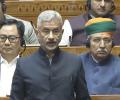
Jaishankar said India-China ties have been abnormal since 2020 when peace and tranquillity in border areas were disturbed due to Chinese actions.
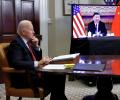
Washington is signalling to Delhi that it can rely on American support in any great game vis-a-vis China. Delhi shouldn't fall into the trap, argues Ambassador M K Bhadrakumar.

Chinese Foreign Minister Wang Yi met with National Security Advisor Ajit Doval in New Delhi, stressing the importance of respecting each other's "core interests" and implementing leaders' consensus for stable bilateral relations. Wang highlighted that India and China should view each other as partners, not rivals, and properly handle sensitive issues like the border dispute to foster cooperation and accelerate the modernisation of the Global South.

The Nepalese foreign minister was speaking to the media a day after holding wide-ranging talks with his Indian counterpart S Jaishankar that focused on ways to further expand ties in diverse sectors, including trade, critical technology, connectivity and energy.
Senior officials from India and China's foreign ministries met in Beijing to discuss bilateral ties following a meeting between Prime Minister Modi and President Xi.

Russian President Vladimir Putin and Chinese President Xi Jinping have reaffirmed their commitment to dismantling global hegemonism and building a 'multipolar world' during high-level talks in Beijing.

China has reacted positively to Russian President Vladimir Putin's visit to India, emphasizing the importance of trilateral ties between China, Russia, and India for regional and global peace and stability.
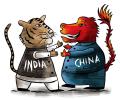
India and China achieved a major milestone this year when their bilateral trade crossed the landmark figure of $100 billion but it did not generate any fanfare in both capitals as the two Asian giants are going through a "particularly bad patch" in their relations due to a set of actions by Beijing in violation of agreements that led to the military standoff in eastern Ladakh. Starting with a modest $1.83 billion in 2001, the bilateral trade crossed $100 billion-mark in the first 11 months this year, a significant milestone for which the two countries carried out campaigns to boost trade and build it as a major stakeholder to improve the relations between two nations, whose ties otherwise remained frosty over the festering boundary dispute and strategic rivalry. According to last month's data from China's General Administration of Customs (GAC), the India-China bilateral trade totalled $114.263 billion, up 46.4 per cent year-on-year from January to November 2021.

Defence Minister Rajnath Singh met his Chinese counterpart Admiral Dong Jun in Bishkek to discuss maintaining peace and tranquility along the Line of Actual Control (LAC) and broader regional security concerns.

'It is disappointing that a craft, which is protected by the Geographical Indication Tag, Polo Ralph Lauren has turned it into a cheap wrap skirt, that too, printed.'
Chinese President Xi Jinping described India and China as "good neighbours, friends and partners", saying that achieving "dragon and elephant dancing together" is the right choice for both countries.

The external affairs minister also recalled how Pandit Nehru was hesitant in taking assistance from the United States following the 1962 war with China as he was unsure how it would be seen.
China firmly opposes the Trump administration's 50 percent tariffs on India as it is "unfair and unreasonable" and New Delhi and Beijing should scale up economic ties to jointly counter the challenge, Chinese ambassador Xu Feihong said on Monday.

'Vijay Gokhale's appointment as foreign secretary can be regarded as a certain 'adjustment' that could make a difference to the poor climate of India-China relations,' says Ambassdor M K Bhadrakumar.

The US embassy spokesperson issued a statement clarifying President Trump's views on India after a controversial social media repost. The statement emphasised the strong relationship between the two countries and Trump's positive view of India's leadership.

'We won not (only) because we were able to carry out long-range precision strikes.' 'That is, of course, one of the reasons but we had better situational awareness about what's happening than Pakistan.'

Jaishankar said the last few years have been a "period of serious challenge", both for the relationship and for the prospects of Asia, noting that continuation of the current impasse will not benefit either India or China.

Iranian Foreign Minister Abbas Araghchi is in India for a BRICS foreign ministers' meeting, where discussions will focus on the escalating crisis in West Asia and its impact on global energy supply chains.

Without mentioning the boundary dispute, the spokesperson said that China-India relations have been stable on the whole and "our two sides have maintained dialogue and communication at various levels".

With regard to where relations between New Delhi and Beijing stand, the Union minister said that he does not have a definite answer to offer at "this moment".

India would confront a more entrenched China, a less dependable United States, and a regional order increasingly shaped by great-power bargaining over which it exercises limited influence, notes Amberish K Diwanji.

He said that "the state of the border will determine the state of the relationship, that's natural".
